This article addresses three key areas. The first one is the modernisation of municipal waste sorting plants – its nature, needs, and directions. The second concerns communication between the contracting authority (investor) and the contractor, which forms the foundation for proper investment preparation. The third element is preliminary market consultations (PMC), a tool that enables such communication.
In this context, several essential questions arise: How to prepare substantively for the modernisation of a sorting plant? How to define the directions of modernisation so they correspond to the real needs of the waste‑management system? How – and to what extent – a dialogue may take place between the contracting authority (a public entity) and the contractor?
This article complements the previous publication dedicated to the needs, limitations, and opportunities of municipal waste sorting plant modernisation (read more).
Modernisation of Waste Sorting Plants – Meaning and Complexity
The modernisation of municipal waste sorting plants is a complex investment process involving the reconstruction of existing technological lines. It may be understood more broadly as actions aimed at modernising plant infrastructure, sometimes including a construction of a completely new installation. Each such investment has the nature of a project and consequently comes with its own limitations. It requires financial expenditure, time for preparation and implementation, and adequate space. Its results are long‑term, and the significance of a modernisation stems not only from the associated costs, but primarily from the effects it may generate – its impact on the functioning of the waste‑management system and the objectives it can serve. Modernisation is a change which, when appropriate criteria are met, can support development and align with both local (micro) and national (macro) waste‑management policies. It is a complex process requiring the integration of interdependent elements: legal frameworks, waste‑policy directions, waste‑management system structure, economic mechanisms, market conditions, and technological solutions, all while considering the unique characteristics of a specific plant.
The starting point for any modernisation lies in the present – in the real conditions that reveal specific needs, limitations, and opportunities. It is also the stage requiring an answer to a fundamental question: should the project’s overriding goal be technological effectiveness or economic efficiency? These two variables are not always aligned. At the same time, the modernisation process looks to the future, accompanied by uncertainty and variability. Two primary dimensions of uncertainty concern waste streams – their mass and morphology – and economic values shaped by market forces and political decisions. The key challenge is therefore to shape the modernisation so that the installation or operational processes can be later adapted to changing conditions.
Four Dimensions of Modernisation Needs
Modernisation needs can be defined through four fundamental dimensions:
- waste‑management goals, which set the direction for systemic and technological changes,
- directions arising from the Packaging and Packaging Waste Regulation (PPWR), which defines new requirements for recycling and packaging design,
- characteristics of waste streams and their material‑recovery potential,
- the technological level of municipal waste sorting installations.
Needs Resulting from Waste‑Management Objectives
Waste‑management goals include in particular:
- preparation for re‑use and recycling of municipal waste – 55% by 2025, 60% by 2030, and 65% by 2035,
- reduction of municipal waste sent to landfill – to a level not exceeding 10% by 2035,
- achievement of required recycling levels for packaging waste – 65% by 2025 and 70% by 2030, including: plastics – 55%, wood – 30%, ferrous metals – 80%, aluminium – 60%, glass – 75%, paper and cardboard – 85%.
Achieving these goals does not follow automatically from legal provisions or strategic documents. Current performance still deviates significantly from required values, clearly indicating the need to modernise municipal waste sorting plants. What is more, achieving these objectives is possible only with the active participation of the market – including the industry, recyclers, and consumers.
The PPWR as the Second Dimension of Needs
The directions defined in the PPWR form the second dimension of modernisation needs. The regulation sets long‑term (spanning several or more years) directions for the development of processing technologies, including sorting processes for packaging and municipal waste.
Implementation of PPWR assumptions should lead to changes in waste morphology: a higher share of recyclable materials, increased density, more fine fractions, and stronger demand for secondary raw materials. These factors may improve plant conditions due to better input composition and rising demand for materials. However, they will also complicate sorting conditions, particularly where manual work is still predominant.
Consequently, PPWR‑related directions, combined with waste‑management objectives, will require greater automation of sorting processes, higher sorting efficiency, and greater focus on fine fractions and waste streams currently treated as process losses. This combination of challenges forms the next dimension of modernisation needs.
Third Dimension – Waste Streams and Their Changes
The third dimension is defined by municipal waste streams and their evolution, analysed in relation to waste‑management objectives and system directions. This article focuses on two key streams:
- separately collected plastic waste (“the yellow bag”),
- mixed municipal waste.
The analysis used data from the Institute of Environmental Protection – National Research Institute for 2022 (Table 1). Based on own data on secondary raw‑material fractions with potential for recycling, the mass potential and composition of these materials were estimated across both streams.
The analysis shows that the dominant share of secondary raw materials present in total waste mass originates from mixed waste. This is not due to high recyclable content in mixed waste but to its overall volume.
Table 1. Structure of material‑recovery potential in municipal waste, including separately collected plastics and mixed waste.
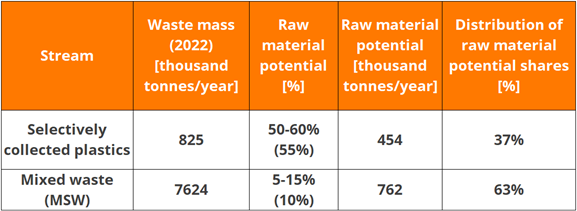
Source: Own calculations based on waste‑mass data provided directly by the Institute of Environmental Protection and data contained in “Reports of regional marshals on municipal waste management performance in 2022”, IOŚ‑PIB, 2024 [1].
Table 2 is based on data presented in the “Regulatory Impact Assessment for the draft Act on Packaging and Packaging Waste” of 7 August 2025. It shows the share of packaging waste in municipal waste streams. Using the percentage shares and mass values indicated in the document, the mass of individual waste streams and the distribution of packaging waste were calculated.
Results are consistent with Table 1: the majority of packaging waste requiring sorting and preparation for recycling still occurs in mixed municipal waste. This means the efficiency of the waste‑management system depends heavily on the ability of sorting plants to recover materials from this stream.
Table 2. Structure of packaging waste in mixed and separately collected municipal waste.
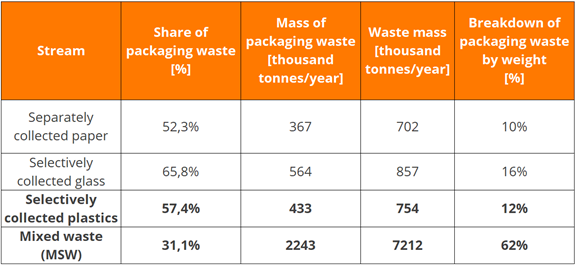
Source: Own calculations based on data on the share and mass of packaging waste contained in the “Regulatory Impact Assessment for the draft Act on Packaging and Packaging Waste”, 7 August 2025 [2], p. 20.
In the context of the deposit‑return system, shaping of extended producer responsibility (EPR), and long‑term PPWR requirements, monitoring and analysing changes in waste streams is crucial. These changes will directly affect waste composition, structure, and characteristics, and thus the requirements for sorting technologies.
These conditions constitute the third dimension of the modernisation needs of sorting plants, indicating the need to flexibly adapt sorting processes to dynamically changing waste streams and new regulatory frameworks for waste management systems.
Technological Deficiencies as the Fourth Dimension of Needs
The last of the basic dimensions determining the need for modernisation of sorting plants concerns the technological level of municipal waste sorting installations. An analysis prepared in 2024 determined the share of installations sorting mixed waste and selectively collected plastics, whose technological advancement enables the effective separation of raw material fractions, in relation to the number of installations necessary to process the entire stream of this waste.
This share was estimated at only 20-30% of the existing needs3. This means that the current technological capabilities for sorting and preparing municipal waste for recycling are significantly different from the actual requirements of the system. On a national scale, there is therefore a significant deficit in technological infrastructure and an insufficient level of its advancement, which directly translates into investment needs in this area. The modernisation of municipal waste sorting infrastructure should therefore include both the construction of new installations and upgrading or equipping existing sorting plants so that they can achieve the required levels of recovery and preparation for recycling in accordance with the applicable legal regulations.
Individual Conditions of Sorting‑Plant Modernisation
The analysis of external and systemic factors must always be related to the individual situation of a specific installation. The modernisation of each waste sorting plant therefore has an additional dimension of needs resulting from its local and technical conditions. It is these conditions that determine the actual scope and nature of the modernisation measures.
The most important individual factors include:
- changes in waste streams and morphology,
- existing technological installation – its functionality, technical condition, and compliance with standards,
- hall parameters – size, height, structural layout,
- condition of supporting infrastructure (transport systems, power supply, auxiliary objects),
- site layout – expansion potential, logistics, traffic flow,
- operational experience and investor expectations,
- business and technological goals, including required throughput and material‑recovery levels,
- time and budget limitations,
- administrative and environmental‑permitting requirements.
Each of these elements influences how modernisation needs are defined, the choice of technology and the shape of the final investment concept. The modernisation of a sorting plant is therefore always an individual process, requiring consideration of both the systemic objectives of waste management and the specific conditions of a given location.
Directions of Modernisation
Modernisation directions emerge from the intersection of systemic requirements and individual plant limits. Particular attention should be given to:
- incoming waste streams and their stability, ensuring at least baseline sorting capacity,
- potential to achieve higher recovery levels depending on the future development of EPR,
- factors determining investment effectiveness, including waste input mass, recovery levels, and unit economic value of recovered materials.
Modernisation measures should therefore be designed in such a way as to enable flexible adaptation of the installation to future regulatory, market and technological changes, while ensuring the stability of current operations.
Need for Communication During Investment Preparation
Owners and managers of facilities, when faced with the preparation of an investment involving the construction of a new or modernisation of an existing waste sorting line, are aware that the conditions described above must be translated into a specific investment project. This project is primarily technological in nature, as it is the technology used that determines whether the complex needs associated with the modernisation of the sorting plant are met. The sustainability of the project’s results depends on the quality of the solution developed and implemented. This, in turn, emphasises the importance of proper preparation for an investment that is specialised, complex, long-term and technically advanced.
The success of a project is not a matter of chance. As Benjamin Franklin reminded us, “failure to prepare is preparing to fail”. In the case of infrastructure investments, success is directly proportional to the quality of the project preparation stage.
On the other hand, those responsible for preparing the investment on behalf of the investor – often a public contracting authority – usually do not have sufficient technological knowledge to prepare the project on their own. They lack experience in technological solutions that are both possible and necessary to apply in a specific situation. These are solutions that will ensure the achievement of investment objectives, reliability of operation, environmental benefits, stability of operation and the ability to perform tasks related to waste processing and preparation for recycling. Acquiring this knowledge at the investment preparation stage is therefore crucial for making the right decisions.
In a situation where the investor is willing to act and is aware of the importance of the planned investment, but lacks technological knowledge, there is a natural need for communication – a dialogue between the contracting authority and the technology contractors. Contractors, based on their many years of experience and numerous projects, have the practical knowledge necessary to understand the real technical and functional possibilities and to develop a technological solution. The aim of such communication is for the investor to acquire knowledge that they do not have themselves, but which is necessary for the proper preparation of the investment.
Communication – the Foundation of Investment Preparation
The experience of technology suppliers allows for better definition of investment goals, selection of appropriate solutions, and avoidance of inefficient spending. Practice shows that the cost of a poorly designed installation is not only a lost budget, but also wasted time, space, technological potential of the plant, and new problems that will require additional attention and financial outlays in the future.
There are no “standard products” in this type of project. Each installation is unique, tailored to local conditions, existing infrastructure, waste stream characteristics, site conditions and technological objectives. Therefore, the contractor cannot provide a template answer, as they do not have a ready-made “catalogue product”. Each project requires an assessment of needs, data analysis and the development of an individual technological solution. As a result, communication between the client and the contractor becomes not only necessary, but essential for the success of the entire investment process.
This communication concerns not only the technological solutions that can be applied, but also how they can be adapted to the specific needs, limitations and capabilities of a particular installation. The contractor is not able to propose an adequate solution without first knowing the individual conditions of the investment.
Therefore, the exchange of information between the investor and the contractor is a natural and necessary process. It is thanks to this exchange that the investor can obtain the knowledge necessary to properly prepare the investment. Effective communication between the investor and the contractor at the investment preparation stage is not an addition to the process, but its foundation.
Preliminary Market Consultations (PMC)
Developing a technological solution for the modernisation or construction of a new waste sorting plant is a complex process that requires analysis, the use of knowledge and experience, the exchange of information, consultation and the involvement of many parties. This naturally raises the question: how is such an exchange of information and consultation possible, especially when the contracting authority is a public entity?
How can the contracting authority prepare an investment in the modernisation or construction of a new sorting plant, using knowledge and experience that it does not possess itself, but which are necessary to make the right technological and organisational decisions?
The instrument that enables a public contracting authority to obtain the knowledge necessary to properly prepare an investment is preliminary market consultation (PMC). This institution is regulated in Article 40 of Directive 2014/24/EU on public procurement. It has also been implemented into the Polish legal system in Article 84 of the Public Procurement Law, effective from 2021.
Polish Public Procurement Office (PPO) Encourages Extensive Use of PMC
The Public Procurement Office (PPO) recognises the “extremely positive role of preliminary market consultations for all parties involved in public procurement procedures” and emphasises on its website: “Preliminary market consultations are an important way of acquiring knowledge about the subject of the contract, as well as an important tool for contractors. Thanks to these consultations, the contracting authority has the opportunity to identify the latest technical, economic and organisational solutions related to the preparation of the procedure. Preliminary market consultations are a tool that facilitates the application of innovative, technologically advanced and environmentally friendly solutions. On the other hand, by participating in preliminary market consultations, contractors have the opportunity to present available technological solutions and learn about the contracting authority’s needs related to a specific contract in a much broader scope than usual4.
The PPO has also prepared model documents facilitating the organisation of PMC4:
- PMC Regulations,
- PMC Notice,
- PMC Participation Form.
An important element of the model “Regulations for preliminary market consultations” developed by the Public Procurement Office is §4, which defines the purpose of the WKR as: “obtaining information by the contracting authority to the extent necessary to prepare the procedure and informing contractors about its plans and requirements regarding the contract”5.
The rest of §4 indicates that the subject of the consultation may include, in particular:
- “obtaining technical, organisational, economic and legal information concerning: (a) the description of the subject matter of the planned contract, (b) the possibility of dividing the contract into parts due to its specific nature, (c) the estimated value of the contract, (d) the conditions for participation in the procedure, (e) the essential provisions of the public contract,
- informing contractors about the contracting authority’s requirements for the planned procedure;
- obtaining information related to the performance of the contract and its costs, in accordance with the contracting authority’s needs;
- collecting other information necessary to prepare the documentation for the planned procedure”5.
In addition, the model regulations indicate that: “in the course of consultations, the contracting authority is entitled to limit or extend the scope of the consultation to selected issues, provided that, in its opinion, this will allow it to obtain all relevant information for the planned procurement procedure”5.
PMC in Legal Commentary
The commentary introducing the model regulations for conducting preliminary market consultations draws attention to the issue of efficiency in the award of public contracts. This aspect is established by Article 17 of the Public Procurement Law. It is noted that PMC “may support awarding contracts in the most efficient manner, i.e., allowing the contracting authority to obtain the best possible results from a given contract,” and that they “may be used as an instrument enabling the effective acquisition of a high-quality subject of the contract, appropriate to the contracting authority’s needs and its financial capabilities”⁵.
It is further emphasised that PMC “make it possible to identify technological, organisational, and economic solutions that are appropriate for the contracting authority in the area connected with the subject of the contract.” The commentary also highlights that PMC “constitute an informal and flexible instrument, giving contracting authorities considerable freedom in how they organise and conduct them”⁵.
The informal nature of the consultations – providing the contracting authority with broad freedom in organising and conducting PMC – is also emphasised by T. Korczyński, Ż. Ossowska, and K. Stochniałek. They point out that PMC serve as a tool intended to transfer knowledge from the private to the public sector, and that “the scope of information obtained may be very broad.” Importantly, “thanks to conducting them, the contracting authority has the opportunity to specify its own needs”⁶.
A. Olszewska, President of the Public Procurement Office, draws attention to the aspect of defining and analysing needs and requirements, noting that “analysis of needs is the future of reliable procurement planning,” because “the point is not to buy the cheapest option, but to correctly define the purchasing need”⁷. President Olszewska highlighted the importance of preliminary market consultations: “This procedure is not an end in itself, but merely a tool for satisfying the purchasing need in an optimal way and at the highest level of quality. Unfortunately, contracting authorities often believe they know better than the contractor how a given service should be performed. And sometimes it is worth trusting them. The contractor, in turn, should listen to the voice of the contracting authority”⁷.
Meanwhile, M. Gnacy-Witt and D. Reck emphasise that thanks to PMC, the contractor does not have to operate “from the shadows,” but “can and should actively participate in shaping the content of procurement documentation,” noting that “this is a legal opportunity and a chance to present realistic, market-based, and feasible solutions tailored to the contracting authority’s needs”⁸.
Commentators, however, underline the necessity of respecting the fundamental principles of public procurement – fair competition, equal treatment of contractors, and transparency.
PMC – A Bridge Between Public Procurement and Market Reality
Preliminary market consultations bridge the gap between procedural public procurement and the practical realities of the market. They enable rational investment decisions and increase the likelihood that the modernisation or construction of a sorting plant will be genuinely effective.
The key to achieving this is properly defining the contracting authority’s needs – which are multidimensional and complex. PMC form an invaluable tool enabling transparent and lawful communication between the public sector and suppliers. Such communication is naturally essential to properly prepare investments in the modernisation or construction of municipal waste sorting plants – investments aligned with real needs, not merely procedural requirements.
Sources:
1. Reports of regional marshals on municipal waste‑management performance in 2022, Institute of Environmental Protection – National Research Institute, 2024.
2. Regulatory Impact Assessment for the draft Act on Packaging and Packaging Waste, 7 August 2025.
3. M. Klimek, The technological level of Polish municipal waste sorting facilities in the context of preparing waste for recycling, wastetoeconomy.com.
4. Preliminary Market Consultations – Model Documents, https://www.gov.pl/web/uzp/dokumenty-wzorcowe–wstepne-konsultacje-rynkowe, accessed: 25.10.2025.
5. PMC Regulations, https://www.gov.pl/web/uzp/dokumenty-wzorcowe–wstepne-konsultacje-rynkowe, accessed: 25.10.2025.
6. T. Korczyński, Ż. Ossowska, K. Stochniałek, Czy warto brać udział we wstępnych konsultacjach rynkowych, pro.rp.pl, accessed: 24.05.2025.
7. Preliminary Wstępne konsultacje rynkowe drogą do udanych zakupów publicznych, pro.rp.pl, accessed: 24.05.2025.
8. M. Gnacy‑Witt, D. Reck, Cienka granica między legalną współpracą a niedozwolonym porozumieniem, pro.rp.pl, accessed: 25.10.2025.
Legal Commentary:
According to the report of the President of the Polish Public Procurement Office, in 2024 only 727 procurement notices – just 0.56% of all notices – indicated the use of preliminary market consultations. This surprisingly low figure clearly shows that this institution, despite its potential, is still not widely used and requires greater promotion among contracting authorities.
For our public‑sector clients we recommend using preliminary market consultations – as I often emphasise, it is “tailoring the procurement to real needs”. Many contracting authorities struggle to describe the subject of the contract properly. On one hand, they must conduct the procedure; on the other, they lack sufficient technical knowledge to specify what and how to order.
PMC help solve this problem. They enable contracting authorities to verify their needs, which translates into an accurate description of the contract, better definition of participation requirements, and ultimately – more effective spending of public funds.
The Public Procurement Law expressly allows the use of supplier expertise during PMC. Consultations must, of course, be conducted carefully to avoid distorting competition or breaching principles of non‑discrimination and transparency. However, such a dialogue with the market is fully lawful and compliant with the Public Procurement Law.
– Daniel Reck, Managing Attorney, Duraj Reck & Partners