The Czech EPR (Extended Producer Responsibility) model, presented in previous publications, implies solutions that motivate facilities to maximize efficiency in municipal waste sorting. It financially promotes the receiving of selectively collected waste for processing and motivates facilities to recover every ton of raw materials. The Czech EPR encourages achieving the maximum possible levels of raw material fraction recovery and preparation for further recycling. The amount of subsidies depends on the type of raw material and the structure of the sorted fractions. Additionally, increasing product diversity, for example, separating a wide spectrum of raw materials and producing RDF fuel from sorting residues, is rewarded.
The Czech EPR model is a mechanism that enables the implementation of waste management goals. It is a mechanism that ensures the profitability and provides economic stability for facilities. These are the basic economic conditions for the implementation of proper and continuous sorting processes. These economic conditions motivate facilities to achieve their operational goals: to process waste, to achieve high levels of recovery, and to prepare waste for recycling.
The purpose of this article is to present the basic mechanisms of the Czech EPR system and to try to answer these questions: What is the level of municipal and packaging waste recycling in the Czech Republic? What is the average monthly cost of waste management per capita? Why is the Czech Republic investing in the construction of waste incineration plant? Who is responsible for meeting with requirements concerning recycling levels in the Czech Republic? Are the results of the Czech waste management determined by the control and penalty system? Who covers the costs of collecting, sorting, and recycling packaging waste? Does the eco-modulation mechanism affect the costs incurred by producers? What is the annual budget of the Czech EPR system? What are its funds spent on? Who does receive the highest compensation from the EKO-KOM system and for what services? What are the factors that influence the amount of compensation for municipalities, sorting plants, and recyclers? What are the factors that determine the effectiveness of the Czech EPR system and waste management? What are the results of this system? Can the Czech EPR model serve as an indication for Polish solutions?
What are the recycling levels? How much does the waste management system cost in the Czech Republic?
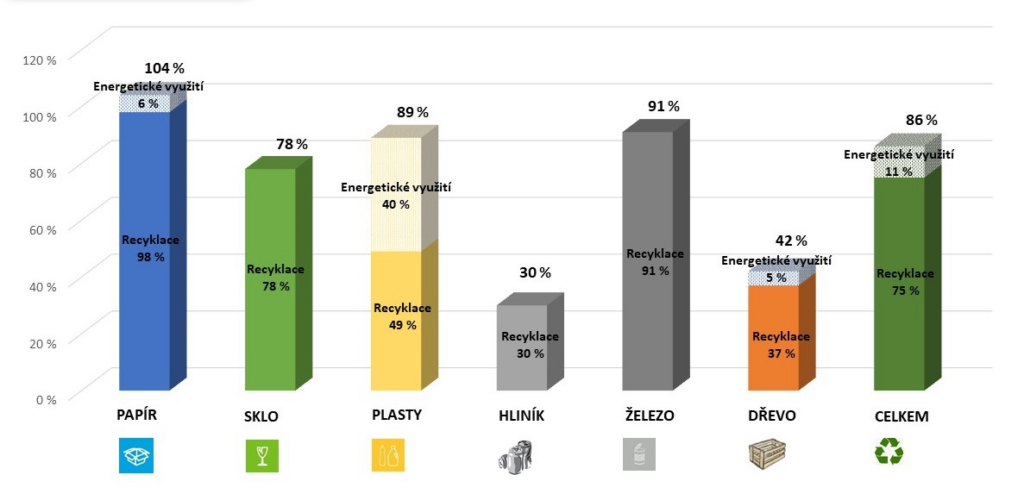
Although the Czech Republic is a close neighbor of Poland, and their economies and living standards are at a similar level, the Czech waste management differs from the Polish approach. The Czech model is designed to be effective and deliver measurable results. The recycling rate of municipal waste in the Czech Republic in 2022 was 41%[1], and for packaging waste in 2023 – 75% [2].
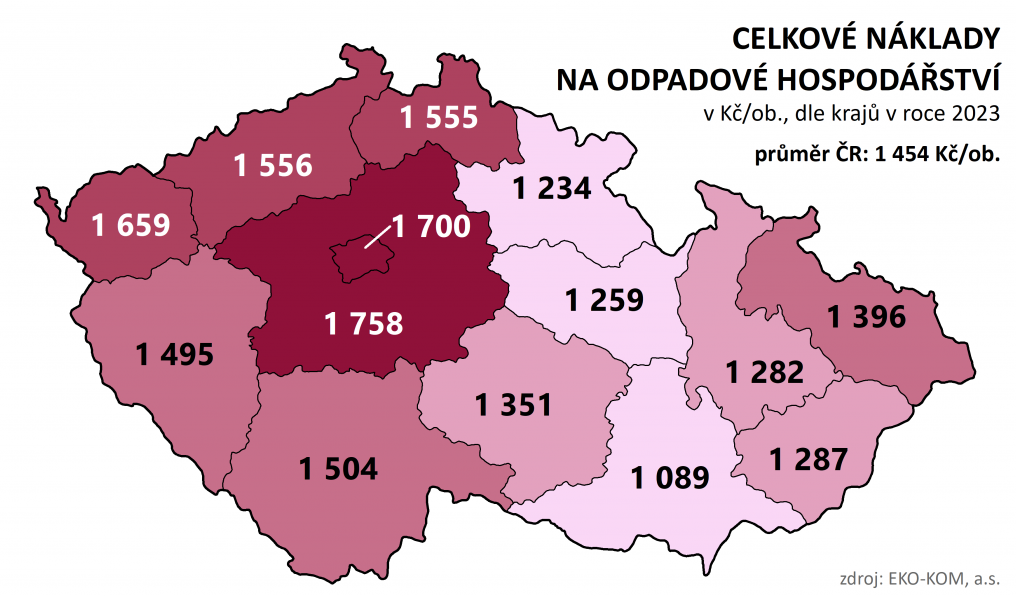
In Czech municipalities, cleanliness is a priority, facilitated by a dense and easily accessible network of waste collection containers. It is also intended to be inexpensive for residents. In 2023, the average monthly cost of waste management per person was approx. 20 PLN [2]. However, not all costs are borne by residents.
Figure 1. Total annual expenditure on waste management in the Czech Republic in CZK/person/year in 2023.
Source: www.ekokom.cz
Translation: Průměr ČR – the average cost (CZK/person) in Czech Republic.
Optimizing Waste Management Costs
The Czechs have obtained the possibility to landfill mixed municipal waste until 2030. Consequently, there is not yet significant pressure to build sorting plants for its processing. The technological advancement of Czech installations is much lower than in Poland.
As part of the decarbonization program, the Czech Republic has focused on the development of waste incinerators, primarily intended for processing the high-calorific fraction. The construction of thermal waste management infrastructure allows for the reducing of total waste management costs. This, in turn, translates into the amount of fees for residents. For this reason, a fuel preparation module is often an integral part of the construction and modernization projects of sorting plants in the Czech Republic.
The Czech EPR System truly supports entities in achieving environmental goals – the mechanism of economic motivation
Czech municipalities, of which there are as many as 6,258, are obliged to selectively collect waste, but they are not responsible for achieving recycling levels. It is the state that is responsible for this task , and in practice – the Czech Minister of the Environment. Such a system has significant practical consequences.
The Czech Republic pursues an active economic policy focused on achieving environmental goals, adapting, within the system’s means, the tools of this policy to changing market conditions. There is a support and motivation mechanism in place, and the policy, based on precisely collected and analyzed data, is aimed at achieving specific results. This is a different approach from a model where responsibilities are shifted onto municipalities, which do not have: a real impact on achieving recycling levels, and a system of control and penalties as the main tools of motivation; and which lack appropriate market mechanisms and real state support.
In the Czech Republic, there is an EPR system that economically supports, among others, municipal waste sorting plants, motivating them to achieve waste management goals. It ensures the stability and profitability of the sorting process and is also one of the cheapest systems in Europe for packaging producers.
Similar to Poland, there is a discussion in the Czech Republic about the introduction of a deposit return system. However, the domestic waste industry strongly disapproves of the model adopted in Poland. Therefore, there is a high probability that the Czechs will opt for a different solution.
Producers fund the collection, sorting, and recycling of packaging waste
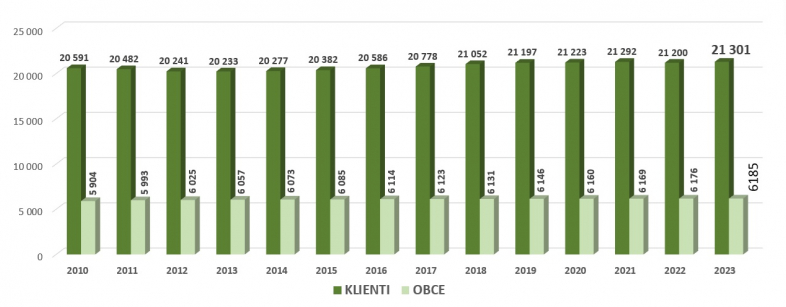
Producers, who are the system’s clients (over 21,300 entities), pay fees to EKO-KOM – the system’s coordinator – for placing packaging on the market. The amount of these fees depends on the quantity and type of packaging and is determined based on a uniform, public price list based on eco-modulation instructions. Its purpose is to motivate producers to use packaging with lower collection and recycling costs, that is, easier to sort and process.
The revenues of the EKO-KOM budget come from payments made by entities placing packaging on the market. Based on market data, it can be estimated that this budget is approximately 3 billion Czech crowns, or about 500 million zlotys3. The collected funds cover the costs of collecting, sorting, and recycling packaging waste, and also allow for the creation of a mandatory reserve. Calculations indicate that the EKO-KOM system finances approximately 15–20% of the annual municipal waste management costs in the Czech Republic [3].
Figure 2. The number of producers and municipalities in the EKO-KOM system.
Source: www.ekokom.cz
Translation: Klienti – clients introducing packaging to the market; Obce – municipalities.
How does the Czech EPR System work?
The packaging waste management system in the Czech Republic consists of several key elements. Producers introduce packaging onto the market, consumers buy packaged products, and then throw the packaging into appropriate waste containers. Collection companies transport the waste to sorting facilities, where individual material fractions are separated. They then go to recyclers, who process them into new products.
From a financial perspective, the system is based on fees paid by producers for introducing packaging to the market and on compensations paid to entities participating in the collection, recovery, and recycling of waste.
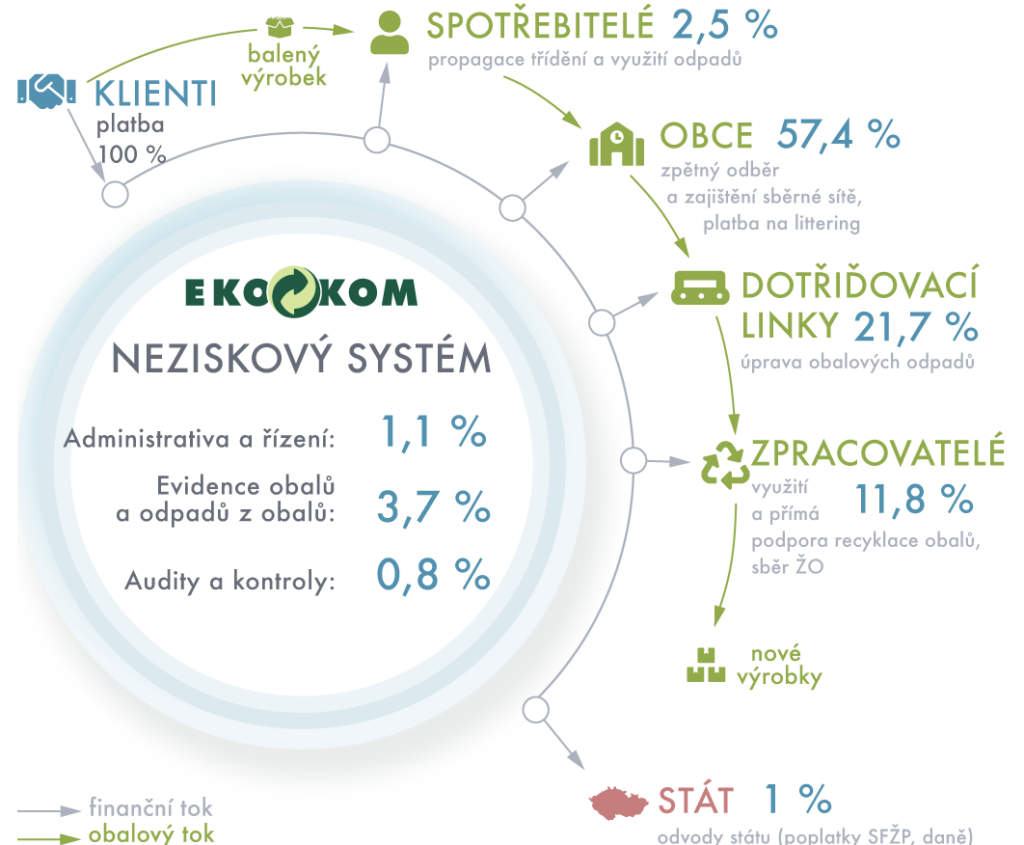
EKO-KOM spends approximately 91% of the funds collected in the system to cover the operating costs directly related to waste management. These funds cover the costs of activities such as collection and providing a collection network in municipalities, cleaning packaging from public spaces, processing packaging waste, its recovery, and supporting recycling processes [2].
Producers introduce products in packaging to the market, which reach consumers. To increase the efficiency of the system, EKO-KOM runs information and educational campaigns on sorting and reusing products. Approximately 2.5% of the total funds collected in the system are allocated to these types of actions [2].
Raising public awareness of sorting and recycling, combined with an easily accessible and well-developed collection system, are the basic conditions for building an effective packaging waste recycling system.
Figure 3. The EKO-KOM system.
Source: www.ekokom.cz
Translation: Neziskový system – the non-profit system, administrative a řízení – administration and management, evidence obalů a odpadu z obalů – packaging and packaging records, audity a kontroly – audits and controls, platba – compensation, spotřebitelé – consuments, obce – municipalities, dotřídovací linky – waste sorting lines, zpracovatelé – recyclers, nové výrobky – new products, finanční tok – financial flow, obalový tok – packaging flow.
How are municipalities compensated in the Czech EPR Model?
The largest portion of funds from the Czech EPR system goes to municipalities. Out of the 6,258 municipalities in the country, 6,185 have signed agreements with EKO-KOM. They receive compensation for providing a packaging waste collection system, handing it over to waste collection companies, and for cleaning up packaging left in public places. In 2023, municipalities received 57.4% of the funds from the EKO-KOM system [2].
The denser the network of containers in a given municipality, the shorter the distance residents have to travel. This makes waste sorting more convenient. Studies have shown that the closer the containers are to residents, the more waste is properly segregated.
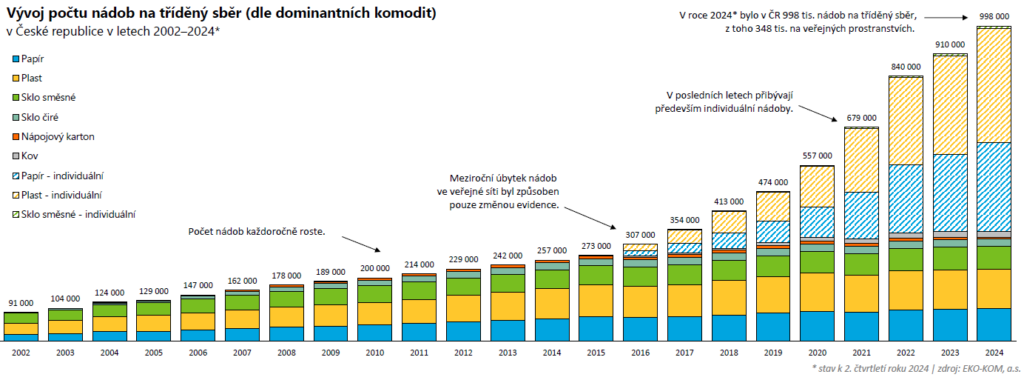
The amount of compensation for municipalities depends primarily on the quantity of selectively collected waste and the packaging content in that waste. The amount of compensation increases with the efficiency of the collection system, which motivates municipalities to develop it and run educational campaigns encouraging residents to properly sort waste. In consequence, collection points are usually available within walking distance, and the Czech EKO-KOM boasts a network of one million containers located throughout the country.
Figure 4. Changes in the number of containers for selectively collected waste in the Czech Republic.
Source: www.ekokom.cz
Translation: Vývoj počtu kontejnerů na tříděný sběr – the increasing number of containers for selectively collected waste.
The amount of the compensation for sorting facilities depends on their efficiency
In 2023, municipal waste sorting facilities received 21.7% of the total funds from the EKO-KOM system [2]. A compensation is granted based on the amount of waste accepted for processing. Additionally, it takes into account the amount of sorted raw materials and the production of fuel from waste. Thanks to this, facilities are motivated to increase the amount of waste processed, as well as to maximize the recovery of raw material fractions, to separate a wide spectrum of raw materials, and produce fuel for energy recovery from residues after segregating recyclable materials.
This financing system corresponds to the economic mechanism of sorting facility efficiency. It is consistent with waste management goals and encourages facilities to achieve them in a market-driven way. It is also simple, transparent, and creates stable economic conditions conducive to the modernization and construction of new waste processing infrastructure throughout the country.
The mechanism for compensating waste sorting facilities within the Czech EPR system is discussed in detail in the article titled “Municipal waste sorting facilities facing new challenges: increasing recycling rates, the deposit return system, and the Extended Producer Responsibility” [4].
Figure 5. Compensations’ amount for waste sorting facilities.
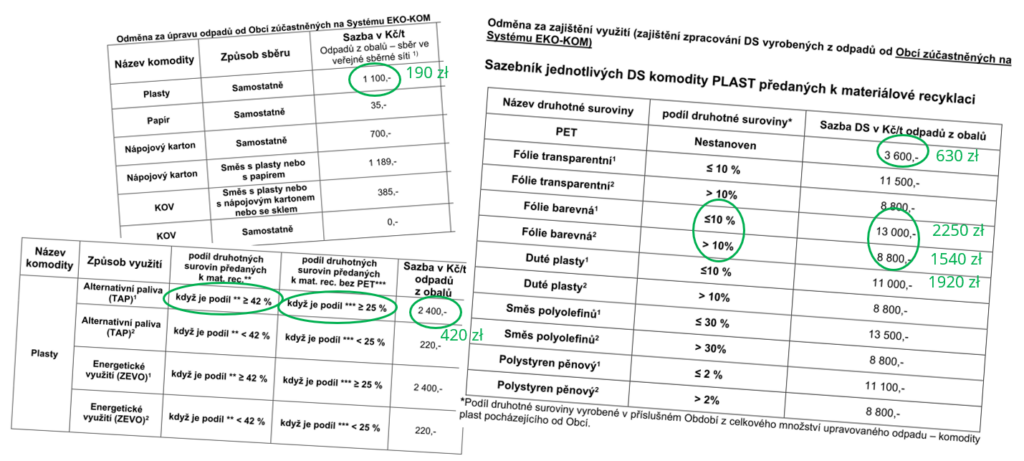
Source: own elaboration based on the data from www.ekokom.cz.
A wider commentary on the compensation mechanism for sorting facilities can be found in the article titled “Municipal waste sorting facilities facing new challenges: increasing recycling rates, the deposit return system, and the Extended Producer Responsibility” [4].
Recyclers are an essential element of the packaging waste management and EPR system
Another link in the system are recyclers, who received 11.8% of the total funds from the EKO-KOM system in 2023. These funds were allocated to directly support the recycling of packaging waste2. Financial support is particularly important for difficult-to-process waste, for which the recycling process is not profitable under standard market conditions.
It is crucial that recyclers receive compensation only when packaging waste has been processed into a final product which then enters the European market, in accordance with current regulations.
The development of the Czech waste management system
EKO-KOM supports the building and development of the system by collecting detailed data and conducting numerous analyses. These cover elements such as waste morphology, waste collection network, processing technologies, and economic analyses. Based on this data and practical knowledge of the system’s operation, reports and recommendations are developed, including those regarding the network of waste collection containers, technological requirements for sorting plants, etc.
Similarly, rates for packaging producers and compensation for municipalities and facilities are also determined. The goal is to develop the system in such a way that it is effective and delivers the expected results with justified expenditures.
What are the results of the Czech packaging waste management system?
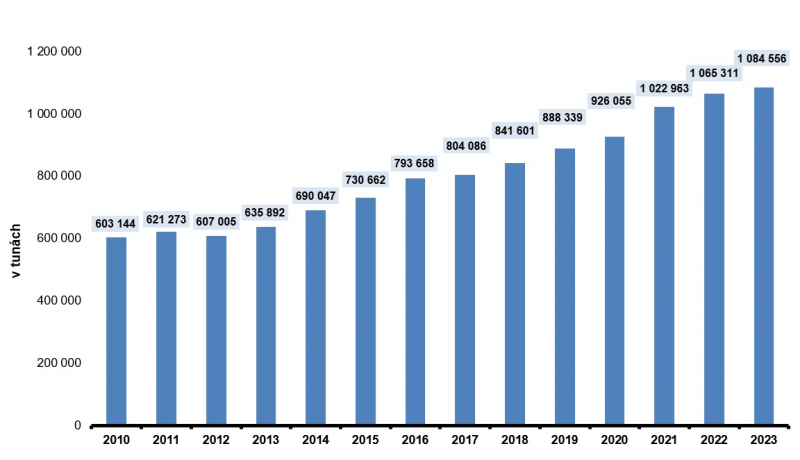
In 2023, 1.26 million tons of packaging waste were placed on the market, of which 1.08 million tons were recycled, or recovered energetically. This represents 86% of all packaging placed on the market in 2023. In turn, 75% of packaging waste was recycled [2].
Figure 6. The amount of collected packaging waste in the Czech Republic in the years 2010 to 2023..
Source: www.ekokom.cz
Figure 7. Achieved recycling and energy recovery rates for packaging waste in 2023.
Source: www.ekokom.cz
Can the Czech EPR serve as an inspiration for Polish solutions?
Economic and systemic solutions cannot be directly transferred from one country to another, because, despite similarities, there are significant differences in conditions. For example, a Czech municipality is not identical to a Polish municipality. In the Czech Republic, there is one recovery organization, while in Poland there are several dozen. The role of the central government, led by the Minister of the Environment, in waste management also varies.
Despite these differences, the Czech EPR model can serve as a point of reference, and to some extent, as an indication for Poland. It supports every element of the waste management system. The Czech EPR model is aimed at achieving environmental goals, and the tools and mechanisms used (mainly economic) encourage individual participants to adopt desired market behaviours and fulfill their tasks. It is also a model of cooperation between the state, the recovery organization, packaging producers, municipalities, waste sorting and recycling facilities, and citizens.
The last important feature is that the Czech waste management system, supported by the EPR system, delivers results, and its costs, in which residents and producers are involved, are kept at a reasonable level.
In summary, the Czech EPR system is an effectively managed and efficient model that can serve as an inspiration for Poland. Key elements, such as stable financing, the integration of various entities, and motivational compensation mechanisms, could improve the functioning of the Polish waste management system. Although some aspects of the system cannot be directly transferred to Polish realities, Czech solutions are worth considering while developing the Polish EPR model.
Sources:
[1] Odpadová data ČR za rok 2022 hlásí pokles celkové produkce i komunálních odpadů, včetně skládkování. Na hlavu jsme vyprodukovali 553 kg komunálního odpadu, www.mzp.cz, access: 20.02.2025.
[2] www.ekokom.cz, access: January and February, 2025 and direct interviews – MK.
[3] Own calcualtions and estimations – MK.
[4] M. Klimek, Municipal waste sorting facilities facing new challenges: increasing recycling rates, the deposit return system, and the Extended Producer Responsibility, wastetoeconomy.com.
The content of this article has been verified and confirmed by EKO-KOM, a.s.